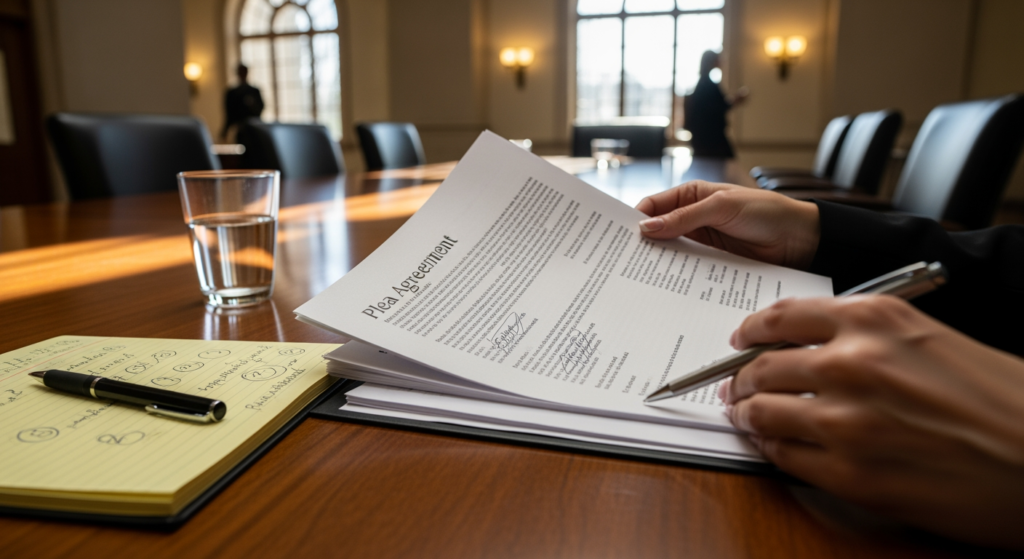
Facing a proposed plea agreement can feel like you’re being asked to sign a contract in a hurry—except the “contract” can affect your freedom, record, and future opportunities. This plea deal checklist is for people who have been charged with a crime (or are supporting someone who has) and want a clear, practical set of questions to bring to a lawyer or use to organize what they’ve been told. In spring, when life tends to shift into “reset mode,” it’s a good reminder that decisions made now can shape what your next season looks like. The goal here is not to tell you what to choose, but to help you understand what a plea offer typically includes, what can be negotiated, and what to clarify before you agree to anything.
For a broader overview of how cases move through the system, see Understanding the Criminal Justice Process.
What You Need to Know First
- ✓ A plea deal is usually a trade-off: you may give up trial rights in exchange for reduced charges, a recommended sentence, or other terms.
- ✓ “What you’re pleading to” matters as much as the sentence: the conviction label can affect employment, housing, licensing, and immigration.
- ✓ The fine print can be bigger than the headline: fees, probation conditions, treatment, no-contact orders, and restitution can be major.
- ✓ Timing and deadlines can pressure decisions: offers may change; continuances may or may not be available depending on the court.
- ✓ You can ask for clarification—on the record: if anything is unclear, it’s reasonable to request that it be explained in plain language.
How Plea Offers Typically Work (Plain English)
A plea agreement is a negotiated resolution where the defendant pleads guilty (or, in some courts, no contest) to one or more charges. In return, the prosecutor may reduce charges, dismiss counts, recommend a particular sentence, or agree not to seek certain penalties. The judge often reviews the plea in court and may ask questions to confirm it’s voluntary and that you understand what rights you’re giving up.
Not every “deal” is the same. Some are tightly defined (specific charge and sentence). Others are looser (a recommendation the judge may accept or reject). Terms can also include requirements like probation, community service, counseling, drug testing, restitution, or staying away from certain people or places.

The Real-World Consequences to Weigh Before You Plead
- Time: A plea may shorten the case, but probation or program requirements can last months or years.
- Cost: Court costs, supervision fees, classes, testing, and restitution can add up beyond any fine.
- Record impact: The specific conviction can affect background checks, professional licensing, school discipline, and housing.
- Future exposure: Some pleas can increase penalties for later charges (for example, repeat-offense enhancements) depending on the jurisdiction.
- Collateral issues: Immigration status, firearm rights, and driving privileges can be affected in ways that aren’t obvious from the sentence alone.
Mistakes That Can Undercut a Plea Decision
- ✓ Treating the offer like it’s “take it or leave it” without questions: many terms are negotiable, but only if they’re identified and raised.
- ✓ Focusing only on jail time and ignoring conditions: probation terms, no-contact orders, and treatment requirements can be the hardest part to live with.
- ✓ Not confirming whether the judge is bound by the agreement: in some setups, the judge can reject a recommendation or impose different terms.
- ✓ Overlooking what happens if you can’t complete a program: diversion or deferred options may have strict compliance rules and consequences for non-completion.
- ✓ Assuming “dismissed charges” can’t come back: clarify whether dismissal is final and whether it depends on successful completion of conditions.
- ✓ Pleading without understanding the factual basis: courts often require a record of what conduct you are admitting (or what the state could prove).
- ✓ Relying on informal promises: if it’s not written into the agreement or stated in court, it may not be enforceable.
Your Plea Deal Checklist: Questions to Ask Before You Agree
- ✓ Exactly what charge(s) will I plead to? Ask for the statute/charge name and whether any counts are dismissed or amended.
- ✓ What is the maximum possible penalty for that charge? Knowing the ceiling helps you understand the range and leverage.
- ✓ What sentence is being offered—specific or recommended? Clarify whether it’s a fixed sentence, a cap, a range, or merely a recommendation.
- ✓ Is the judge required to follow the deal? Ask what happens if the judge doesn’t accept the proposed terms.
- ✓ What rights am I giving up? Confirm trial rights, confrontation rights, and appeal limits that typically come with a plea.
- ✓ What are all conditions besides incarceration? List probation length, reporting, travel limits, testing, classes, community service, and any protective orders.
- ✓ What are the financial terms? Identify fines, court costs, restitution, supervision fees, program costs, and payment timelines.
- ✓ What happens if I miss a payment, appointment, or test? Ask about violation procedures, warrants, and whether there’s a grace period.
- ✓ Does this affect my driver’s license or ability to travel? Some pleas trigger license suspensions or travel restrictions through probation conditions.
- ✓ Are there immigration or citizenship risks? If immigration status is relevant, ask for a referral to qualified immigration counsel for consequences review.
- ✓ Will this conviction be eligible for sealing/expungement later? Eligibility varies widely; ask what is known and what requires later review.
- ✓ What evidence is the offer based on? Ask what the prosecution would rely on at trial and what defenses or suppression issues may exist.
- ✓ What deadlines apply to this offer? Clarify when it expires and whether extensions are sometimes granted in your court.
- ✓ Are there alternatives (diversion, deferred adjudication, treatment court)? If available in the jurisdiction, ask what the entry requirements and completion terms are.
- ✓ What will be said in court during the plea colloquy? Knowing the script reduces surprises and helps confirm you understand the admissions.

Professional Insight: What Most People Miss
In practice, we often see people evaluate a plea offer like it’s a single number (months, dollars, or days), when it’s really a bundle of long-tail obligations—probation rules, programs, and “small” conditions that can be easy to violate accidentally. The most useful conversations tend to happen when someone brings a written list of questions and asks for the terms to be explained as day-to-day requirements, not legal labels.
When It’s Time to Talk to a Lawyer (Not Just “Think It Over”)
- ✓ You’re being asked to decide quickly: time pressure is a sign to get clear explanations of consequences and options.
- ✓ The offer includes probation, a program, or a no-contact order: conditions can be complex and fact-specific.
- ✓ You have prior convictions or pending cases: repeat-offense rules and sentencing exposure can change dramatically by jurisdiction.
- ✓ Your job, license, school status, or immigration situation could be affected: collateral consequences may be the biggest risk.
- ✓ You don’t understand what you’d be admitting in court: confusion is a practical red flag—ask for plain-language clarification.
Common Questions Answered
Can a judge reject an agreement reached with the prosecutor?
Depending on the jurisdiction and the type of agreement, a judge may accept it, reject it, or accept the plea while not following a sentencing recommendation. It’s important to ask how your court handles this and what your options are if the judge doesn’t follow the proposed terms.
Is pleading “no contest” the same as pleading guilty?
In many courts, a no-contest plea results in a conviction similar to a guilty plea for criminal court purposes, but it may be treated differently in certain related proceedings. Availability and effects vary by jurisdiction, so it’s worth asking how it works where the case is pending.
What kinds of conditions can be attached besides jail time?
Common conditions can include probation supervision, counseling, substance testing, community service, restitution, stay-away/no-contact orders, and compliance with treatment programs. The exact mix depends on the charge, the court, and local practices.
Does accepting an offer always end the case immediately?
Not always. Some resolutions include ongoing requirements (like probation or diversion programs) and additional court dates. Ask whether there will be review hearings, what completion looks like, and what happens if deadlines are missed.
Can an agreement affect future background checks?
Yes. A conviction, even for a reduced charge, can appear on background checks and may have consequences for employment, housing, and licensing. Whether a record can later be sealed or expunged depends on the jurisdiction and the specific disposition.
Where to Go from Here
A plea decision is easier to evaluate when you break it into parts: the exact charge, the sentence structure, the conditions, the costs, and the collateral consequences. Use the checklist above to slow the process down into clear questions and written answers. If anything feels vague, it’s reasonable to ask for the terms to be stated plainly and confirmed in writing or on the record. This article is educational and not legal advice; a qualified attorney can explain how local rules and your specific facts may change the analysis.
Want More Information?
Download our free resource to learn more about this topic.