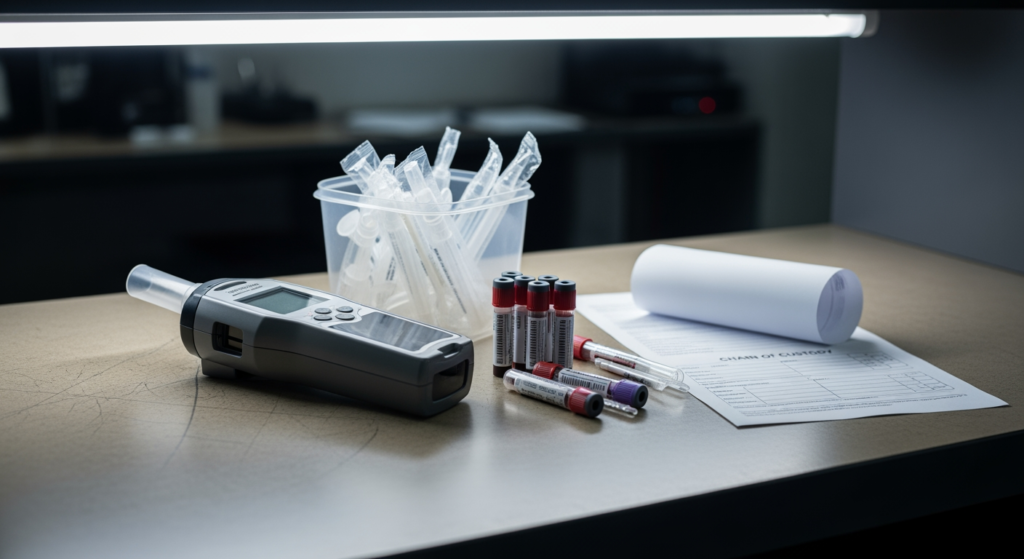
Drivers and families often get stuck on one practical question after a DUI stop: which test matters more—breath or blood—and what can each one actually prove? This comparison is for anyone trying to understand how DUI evidence is gathered, how it’s commonly challenged, and why small details (timing, handling, calibration, and paperwork) can change how evidence is interpreted. As spring brings more nights out and more traffic stops, it’s a good moment to learn how these tests differ before you’re trying to make sense of them under stress. If you want a broader view of how rules can vary depending on where the case is filed, see Understanding the Differences in Criminal Defense Laws Across States.
Bottom Line Upfront: Breath vs Blood
- Breath tests are fast and common, but results can be affected by device maintenance, operator procedure, and timing.
- Blood tests are often viewed as more direct for alcohol concentration, but they rely heavily on collection, storage, and chain-of-custody steps.
- Timing matters for both: the longer the delay after driving, the more room there is for interpretation disputes.
- Paperwork matters: logs, certifications, and lab documentation can be as important as the number itself.
- Best “choice” depends on the situation: medical issues, suspected drugs, and testing conditions can shift which evidence is emphasized.
How Breath and Blood Testing Create DUI Evidence
In many DUI investigations, law enforcement gathers multiple types of proof—driving observations, field sobriety tests, and chemical testing. Breath and blood testing are two common ways to estimate alcohol concentration, but they work differently and create different documentation trails.
| Comparison criteria | Breath test | Blood test |
|---|---|---|
| How it measures alcohol | Estimates alcohol concentration from breath samples | Measures alcohol concentration from a blood sample |
| Typical timing | Often administered shortly after the stop (or at a station) | May occur later due to transport, consent/warrant steps, or medical setting |
| Key reliability dependencies | Calibration/maintenance records, operator training, observation period, proper procedure | Collection method, preservatives/tubes, storage temperature, lab methods, chain of custody |
| Documentation footprint | Device logs, certifications, operator notes, test sequence printouts | Medical/lab forms, custody seals, transfer logs, lab reports, analyst notes |
| Drug detection | Generally not designed to identify specific drugs | Can be paired with toxicology testing for certain substances |
Because each method produces different records, the “strength” of the evidence can turn on whether those records show the test was performed and handled consistently with required procedures. This is one reason two cases that look similar on the surface can play out differently.

The Real-World Stakes: Time, Money, and Case Trajectory
Breath vs blood isn’t just a science question—it can affect how a case moves and what issues become central. Chemical testing may influence charging decisions, pretrial negotiations, and what evidence gets the most attention in court. It can also affect practical costs, because disputes about testing procedures sometimes require additional records requests or expert review.
- Time: Breath testing is often quicker to obtain, while blood results may take longer to process, depending on lab backlogs and procedures.
- Cost/value: Blood testing can involve lab work and additional documentation; breath testing can involve technical device records and maintenance logs. Either can become expensive if expert interpretation is needed.
- Complexity: Blood cases can hinge on chain-of-custody and lab methodology; breath cases often hinge on device reliability and protocol compliance.
- Driver impact: Regardless of method, the downstream effects can include license consequences, employment issues, and insurance complications—often before the case is fully resolved.
Common Missteps That Weaken Breath or Blood Evidence (Checklist)
- Assuming the number is the whole story: The surrounding procedures and documentation often matter just as much.
- Ignoring timing details: When the person drove, when the stop occurred, and when the sample was taken can become central issues.
- Overlooking medical and dietary factors: Certain conditions and substances can be relevant to interpretation, depending on the test method.
- Not preserving records early: Device logs, body camera footage, dispatch logs, and lab notes may be harder to obtain later.
- Talking casually about drinking patterns: Offhand statements can become part of the evidence narrative.
- Missing the difference between screening and evidentiary tests: Some tests are preliminary while others are used as formal evidence, and the distinction can matter.

A Practical Prep List for Comparing Breath and Blood Results (Checklist)
- Write down a timeline: Include when you last ate, when you last drank, when you drove, when you were stopped, and when any test occurred.
- List medications and health conditions: Note anything that could be relevant to symptoms or testing interpretation.
- Request and organize records: Keep citations, release paperwork, tow documents, and any testing paperwork in one place.
- Identify witnesses and locations: Anyone who saw you before/after driving may help clarify the timeline.
- Document language and communication issues: If instructions were unclear or you had difficulty understanding, note it accurately.
- Prepare questions for counsel: Ask what records are typically reviewed for breath devices or for lab testing in your jurisdiction.
Professional Insight: What Most People Miss About These Tests
In practice, we often see people focus on whether breath or blood is “better,” when the more productive question is: “Which steps in this specific case created the cleanest (or messiest) paper trail?” The test result is one piece; the procedures, documentation, and timing are often where disputes actually live.
When It’s Smart to Talk to a DUI Attorney
This article is general information, not legal advice. If you’re dealing with a DUI allegation, consider getting qualified help when any of the following are true:
- You’re facing license suspension or restrictions: Administrative deadlines can be separate from the criminal case.
- There was a crash, injury, or property damage: These situations can raise the stakes and increase complexity.
- You suspect drug involvement: Blood toxicology and drug recognition issues can be technical and record-heavy.
- You have prior convictions or pending cases: Prior history can change exposure and strategy considerations.
- You believe procedures weren’t followed: Examples include unclear instructions, unusual delays, or questions about how samples were handled.
Your Questions, Answered About DUI Testing
Is a blood draw always more accurate than a breath test?
Not necessarily. Each method has strengths and potential failure points. Blood testing depends heavily on collection, storage, and lab procedures, while breath testing depends on device condition and proper administration.
Can timing after driving change how test results are interpreted?
Yes. Delays between driving and testing can create disputes about what the result reflects at the time of driving, especially when the timeline is unclear or contested.
What records are usually important for reviewing a breath test?
Common items include device maintenance and calibration logs, operator training or certification records, the test sequence printout, and any notes about the observation period and procedures used.
What paperwork matters most in a blood-testing case?
Chain-of-custody documentation, seals and labels, transfer logs, lab methodology information, and the analyst’s report and notes are often key to understanding how the sample was handled and tested.
Do these tests address impairment from substances other than alcohol?
Breath testing is generally designed around alcohol. Blood testing may be paired with toxicology analysis for certain substances, but what is tested for and how it’s interpreted can vary by jurisdiction and lab practice.
Where to Go from Here
Breath and blood testing can both play major roles in a DUI case, but they create different kinds of vulnerabilities and different records to review. The most useful comparison looks at timing, procedures, and documentation—not just the final number. If you’re trying to make sense of what happened in your situation, a qualified attorney can explain how these issues are typically evaluated where your case is pending.
Get Your Free Quote
Find out how we can help with a no-obligation quote.