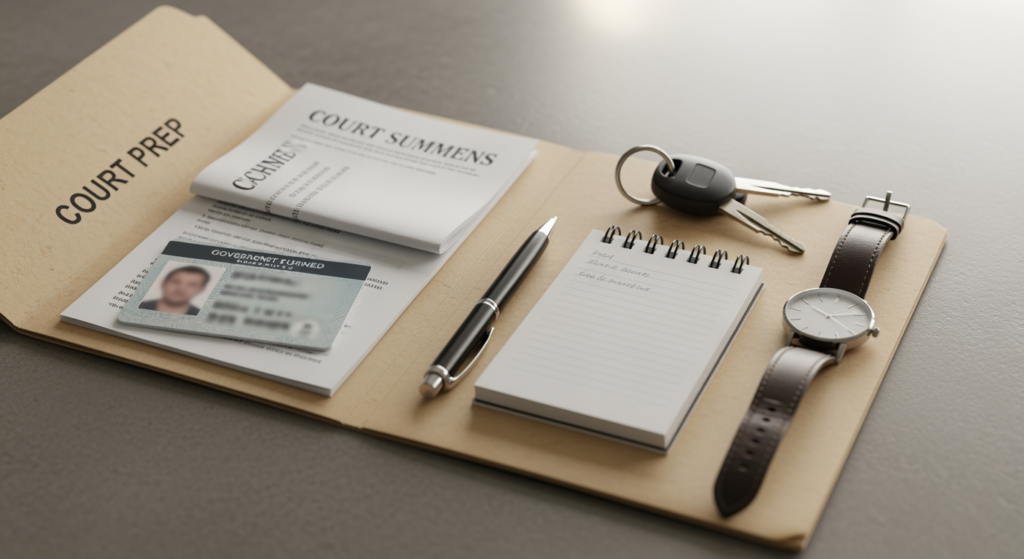
Walking into a courthouse can feel like showing up for an exam you didn’t know was scheduled—especially if you’re unsure what to bring to court and what to leave at home. This checklist is for people attending a criminal court date (as a defendant, witness, or support person) who want to be prepared without overpacking, oversharing, or accidentally creating problems at security. Small details—like the right paperwork, a charged phone (even if you can’t use it in the courtroom), and knowing what items may be restricted—can reduce stress and help the day run more smoothly. Since procedures and allowed items can vary by courthouse and state, it’s smart to treat this as a planning guide and confirm specifics with your attorney or the court.
For a broader overview of how court procedures generally work across the criminal process, see Understanding Criminal Defense Procedures: An Overview.
Key Items to Bring (and Why)
- ✓ Government-issued photo ID: Often needed to enter the building, check in, or verify identity.
- ✓ Court paperwork: Bring your summons/notice, docket or case number, and any court orders so you can reference dates, courtroom, and instructions.
- ✓ A simple notebook and pen: Useful for writing down next dates, instructions, or questions for your attorney—without relying on your phone.
- ✓ Contact info for your attorney (or the court clerk): Have a printed card or written number in case your phone is inaccessible or low battery.
- ✓ Payment method (if applicable): Some people need funds for parking, transit, copies, or possible court fees; accepted methods vary.
- ✓ Essential medical items: Necessary medications or medical devices you may need during a long wait, kept in original containers when possible.
How Court “Bring” Rules Typically Work
Courthouses generally screen everyone through security, similar to an airport—though the exact rules differ by location. Many everyday items are allowed, but some are restricted or may require extra screening. The safest approach is to bring only what you genuinely need for the day: identification, your court documents, and a few practical essentials. If you are represented, your attorney may also tell you to bring specific documents (for example, proof of completion for a class or program, or paperwork related to bail conditions). If you’re unsure about an item—like a medical tool, a recording device, or anything that could be considered “sharp”—checking the courthouse website or calling the clerk’s office can prevent delays.

What’s at Stake if You Show Up Unprepared
Being unprepared usually doesn’t just feel stressful—it can create practical setbacks. You may lose time at security, miss check-in instructions, or struggle to answer basic questions about your case (like the case number or the judge’s courtroom). In some situations, not having the right paperwork can delay progress, lead to rescheduling, or make it harder to show compliance with prior court requirements. On the other hand, bringing too much—especially items that trigger security concerns—can mean long lines, having to return items to your car, or even being denied entry until the issue is resolved. Preparation is less about “bringing everything” and more about bringing the right things.
Mistakes to Avoid at the Courthouse (Medium Priority Checklist)
- ✓ Bringing prohibited or questionable items “just in case”: Multi-tools, pocketknives, pepper spray, and similar items can cause delays or confiscation depending on local rules.
- ✓ Showing up with only digital documents: A dead phone, no signal, or phone restrictions can leave you without the paperwork you need.
- ✓ Carrying stacks of unrelated papers: Extra paperwork can create confusion; bring a clean, labeled set of only relevant documents.
- ✓ Forgetting your case number or courtroom details: Even if you have a notice, writing key details on a separate card can speed up check-in.
- ✓ Bringing friends or family without planning: Some courtrooms limit seating; a support person may need to wait elsewhere.
- ✓ Assuming you can use your phone freely: Many courts restrict photography, recording, or even phone use in certain areas.
Your Court-Day Prep Plan: What to Pack and How to Organize It
- ✓ Use a slim folder with sections: One section for notices/orders, one for notes, one for receipts/proof documents.
- ✓ Print a one-page “case snapshot”: Case number, court address, courtroom, time, attorney contact, and questions you want to ask.
- ✓ Bring minimal personal items: Keys, wallet, ID, folder—less to screen, less to lose.
- ✓ Plan for waiting: A small snack and water may or may not be allowed; confirm local rules and consider eating beforehand.
- ✓ Dress with security screening in mind: Avoid excessive metal accessories that slow screening; keep it simple and respectful.
- ✓ Arrive early enough for security: Lines can be unpredictable; build in buffer time for screening and finding the courtroom.

Professional Insight: The “Too Much Paper” Problem
In practice, we often see people bring a full envelope of unrelated documents because they’re afraid of leaving something out. The result can be the opposite of helpful: it’s harder to find the one page that matters when a clerk or attorney asks for it. A smaller, clearly labeled set of documents is usually easier to use under pressure.
When to Seek Help Before You Go
This checklist is informational and not legal advice. Consider getting professional guidance if any of the following apply:
- ✓ You’re unsure why you were ordered to appear: If the notice is unclear, an attorney can help interpret what the hearing is for.
- ✓ You have conditions to prove (programs, testing, compliance): Ask what documentation is most useful and how it should be presented.
- ✓ You have a pending warrant concern or missed a prior date: Getting advice ahead of time may help you understand risks and procedures.
- ✓ You need accommodations: If you may require language access or disability accommodations, contacting the court in advance can clarify the process.
- ✓ Your case involves potential jail time or serious consequences: It’s a strong signal to consult a qualified criminal defense attorney promptly.
Common Questions Answered
Can I carry my phone into the courthouse?
Many courthouses allow phones through security, but restrict use in certain areas or inside the courtroom. Policies vary, so check local court rules or ask courthouse staff.
Do I need paper copies if I already have everything on email?
Paper copies can be helpful because phones can run out of battery, lose service, or be restricted during proceedings. A small printed set of key documents is often a practical backup.
What documents are usually important for a criminal court date?
Commonly important items include your notice to appear, any court orders, your case number, and any proof documents you were instructed to provide (such as completion or compliance records).
Are there items I should avoid bringing entirely?
It’s generally safer to avoid weapons or anything that could be viewed as a weapon, plus tools or sharp objects that can trigger security concerns. Courthouse security rules can differ by location.
What if I forget something important on the day of my hearing?
If you realize you’re missing a key document or item, you can ask courthouse staff about options and, if you have an attorney, contact them for guidance. Outcomes and next steps depend on the situation and local procedure.
Where to Go from Here
Knowing what to bring to court is mostly about reducing friction: get through security smoothly, check in correctly, and keep your key information easy to access. A simple folder, the right documents, and a plan for waiting can make the day more manageable. If your situation is complicated or high-stakes, consider speaking with a qualified attorney who can explain what to expect in your specific jurisdiction.
Want More Information?
Download our free resource to learn more about this topic.